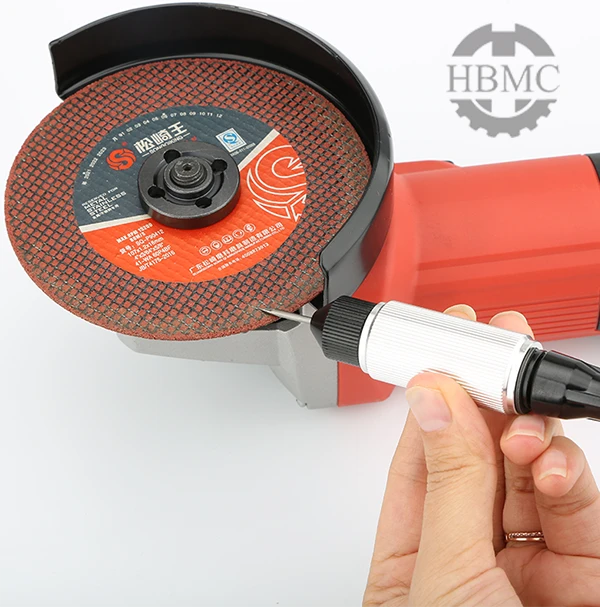
To manufacture a Cutting disc for metal cutting applications, the selection of materials is critical to ensuring durability, cutting efficiency, and safety—each component (abrasive grains, bonding agents, reinforcements) is tailored to withstand high temperatures, mechanical stress, and friction during metal cutting. Below are the main materials used, along with their roles, properties, and why they’re chosen for metal-specific applications:
1. Abrasive Grains: The "Cutting Edge" of the Disc
Abrasive grains are the core functional material of a Cutting disc—they physically remove metal by abrading (scraping and fracturing) the workpiece surface. For metal cutting, grains must be harder than the target metal (e.g., steel, aluminum, stainless steel) and resistant to heat-induced wear (since cutting generates temperatures up to 1,000°C or higher). The most common abrasive grains for metal-cutting discs include:
a. Aluminum Oxide (Al₂O₃)
Aluminum oxide is the most widely used abrasive for cutting ferrous metals (e.g., mild steel, carbon steel, cast iron)—the most common metals in industrial and DIY metalworking.
Key properties: Hardness of ~9 on the Mohs scale (harder than steel, which is ~5–6), excellent toughness (resists fracturing under impact), and good heat resistance (maintains sharpness at high temperatures). It also has a "self-sharpening" trait: as the outer layer of the grain wears down, small fragments break off to expose new sharp edges, ensuring consistent cutting performance.
Why it’s ideal for ferrous metals: It does not react with iron (unlike some other abrasives) and can handle the high friction of cutting steel without rapid degradation. It’s also cost-effective, making it suitable for general-purpose metal-cutting discs (e.g., 4.5-inch discs for angle grinders).
b. Silicon Carbide (SiC)
Silicon carbide is used for cutting non-ferrous metals (e.g., aluminum, copper, brass) and brittle metals (e.g., cast iron, titanium alloys).
Key properties: Higher hardness than aluminum oxide (~9.5 on the Mohs scale) but lower toughness (more brittle). It excels at cutting soft, ductile non-ferrous metals because its sharp, rigid grains can "slice" through the metal without clogging (soft metals like aluminum tend to gum up softer abrasives). It also has strong chemical resistance, so it won’t react with copper or aluminum.
Limitations: Not suitable for ferrous metals—silicon carbide reacts with iron at high temperatures, forming a brittle compound that dulls the grains quickly.
c. Zirconia Alumina (ZrO₂-Al₂O₃)
Zirconia alumina is a premium abrasive blend (typically 30–40% zirconia, 60–70% aluminum oxide) used for heavy-duty metal cutting (e.g., thick steel plates, stainless steel, high-strength alloys).
Key properties: Exceptional toughness (zirconia enhances resistance to impact and fracturing) and heat resistance (maintains sharpness at temperatures up to 1,200°C). It has superior "wear life" compared to pure aluminum oxide—ideal for prolonged cutting tasks (e.g., industrial pipeline cutting) where disc replacement frequency needs to be minimized.
Why it’s used for tough metals: Its toughness prevents grain chipping when cutting hard, high-strength metals (e.g., stainless steel 304), and its heat resistance avoids "glazing" (a smooth, dull layer that forms on grains when overheated).
2. Bonding Agents: Holding Grains Together & Controlling Wear
Bonding agents (or "bonds") act as a "glue" to hold abrasive grains in place on the disc’s substrate (backing material). The choice of bond determines the disc’s rigidity, wear rate, and ability to withstand heat—critical for metal cutting, where the disc is exposed to intense friction and mechanical stress. The main bonding agents for metal-cutting discs are:
a. Resin Bond (Synthetic Resins)
Resin bonds (typically phenolic resins, a type of thermosetting plastic) are the most common for metal-cutting discs—used in 80%+ of general-purpose and industrial metal discs.
Key properties: Excellent flexibility (reduces cracking when the disc vibrates during cutting), good heat resistance (phenolic resins withstand up to 250°C before softening), and controlled wear. The bond wears down at a rate that matches the abrasive grains—ensuring worn grains are shed to expose new ones (preventing glazing) while maintaining the disc’s shape.
Advantages for metal cutting: Resin bonds are non-conductive (safe for use near electrical components) and produce minimal dust compared to other bonds. They also adhere well to both aluminum oxide and zirconia alumina grains, making them versatile for different metal types.
b. Vitrified Bond (Glass-Ceramic)
Vitrified bonds (made from fused glass, clay, and feldspar) are used for high-precision metal cutting (e.g., cutting stainless steel tubes, tool steel) where disc rigidity and dimensional stability are critical.
Key properties: Extremely hard and rigid (maintains the disc’s shape even under high pressure), high heat resistance (withstands up to 800°C), and low wear rate. The bond is inert, so it won’t react with metals or abrasive grains—ideal for cutting reactive metals (e.g., titanium) or metals that require clean, burr-free cuts.
Limitations: Brittle (prone to cracking if the disc is dropped or used with excessive vibration), so they’re not suitable for portable tools like angle grinders (used for rough cutting). They’re primarily used in stationary cut-off machines for industrial precision cutting.
c. Rubber Bond (Elastomers)
Rubber bonds (made from natural or synthetic rubber) are rare for metal cutting but occasionally used for finishing cuts (e.g., deburring metal edges after rough cutting) or cutting very thin metals (e.g., 0.5mm steel sheets).
Key properties: High flexibility (conforms to curved metal surfaces) and low friction (reduces heat buildup on thin metals, preventing warping). The soft bond wears quickly, making it unsuitable for heavy cutting—but ideal for smoothing edges after initial cutting with a resin-bonded disc.
3. Reinforcement Materials: Preventing Disc Breakage & Ensuring Safety
Metal cutting generates high centrifugal forces (e.g., a 4.5-inch disc spinning at 10,000 RPM exerts significant outward pressure) and impact (e.g., when the disc hits a metal burr). Reinforcement materials are embedded in the disc to prevent cracking, fragmentation, or shattering—critical for operator safety. The main reinforcements are:
a. Fiberglass Mesh
Fiberglass mesh (typically 1–3 layers of woven fiberglass) is the standard reinforcement for resin-bonded metal-cutting discs.
Key properties: High tensile strength (resists centrifugal forces that pull the disc apart), flexibility (moves with the disc to avoid cracking), and heat resistance (fiberglass withstands up to 500°C). The mesh is embedded between layers of abrasive grains and bond—acting like a "safety net" to hold the disc together if it chips or develops a crack.
Safety role: Fiberglass-reinforced discs meet international safety standards (e.g., EN 12413) for "breakage resistance," making them mandatory for handheld tools like angle grinders (where disc fragmentation could cause severe injury).
b. Steel Backing (Rare, for Heavy-Duty Use)
Thin steel plates are occasionally used as backing for large, industrial metal-cutting discs (e.g., 14-inch discs for cutting thick steel beams).
Key properties: Extreme rigidity and strength (supports the disc during high-pressure cutting) and heat dissipation (steel absorbs and spreads heat, preventing the bond from overheating).
Limitations: Heavy (reduces tool maneuverability) and conductive (risky near electrical equipment), so they’re only used in specialized stationary machines.
4. Substrate/Backing Material (for Flexible Discs)
Some metal-cutting discs (e.g., thin "slitting discs" for cutting narrow gaps) have a flexible substrate (backing) to support the abrasive and bond. The most common substrate for metal applications is:
a. Fiberboard (Pressed Paper-Fiber)
Fiberboard (made from compressed, resin-impregnated paper or wood fiber) is used for thin, flexible metal-cutting discs (e.g., 0.5mm thick discs for cutting slots in steel).
Key properties: Flexibility (bends slightly to follow curved cuts) and light weight (ideal for precision handheld work). It’s coated with the bond and abrasive grains, forming a thin, agile disc that minimizes material waste when cutting narrow gaps.
Summary: Material Combinations for Common Metal-Cutting Scenarios
General-purpose steel cutting (e.g., mild steel pipes): Aluminum oxide grains + resin bond + fiberglass mesh reinforcement.
Non-ferrous metal cutting (e.g., aluminum sheets): Silicon carbide grains + resin bond + fiberglass mesh.
Heavy-duty stainless steel cutting: Zirconia alumina grains + resin bond + 2–3 layers of fiberglass mesh.
Precision tool steel cutting: Aluminum oxide grains + vitrified bond + rigid ceramic backing.
Each material in the Cutting disc is chosen to work in tandem—abrasive grains for cutting, bonding agents for durability, and reinforcements for safety—ensuring the disc can handle the unique challenges of metal cutting (high heat, friction, and mechanical stress) while delivering clean, efficient cuts.