Choosing the right Welding Machine depends primarily on the thermal conductivity, oxidation tendency, and mechanical properties of the base metal—these factors determine the required welding process, current type (AC/DC), and machine functionality. Below is a detailed guide for three common base metals: steel, aluminum, and stainless steel.
1. For Steel (Carbon Steel, Low-Alloy Steel)
Steel is the most widely used structural metal, with moderate thermal conductivity (≈50 W/m·K) and low oxidation tendency at room temperature. The key is to select a Welding Machine that ensures deep fusion (for structural strength) and avoids excessive spatter or cold cracks.
Step 1: Match the Welding Process to Steel Thickness
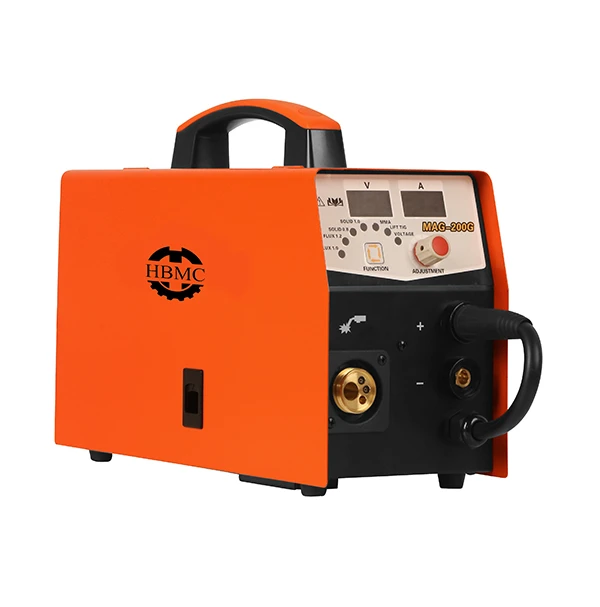
Prioritize a MIG Welding Machine (Gas Metal Arc Welding). MIG uses a continuous filler wire and shielding gas (argon + CO₂, typically 80%Ar/20%CO₂), which enables fast, low-spatter welding—critical for avoiding burn-through on thin steel. Look for a MIG Welding Machine with adjustable wire feed speed (WFS) and voltage (range: 14–22V, 40–180A) to fine-tune heat input.
Alternative: A small inverter-based Stick Welding Machine (with 2.5–3.2mm electrodes) works for occasional repairs, but MIG is more efficient for thin materials.
Two options are ideal:
Stick Welding Machine (Shielded Metal Arc Welding, SMAW): The most cost-effective choice for outdoor or heavy-duty use (no shielding gas required). Select a machine with a current range of 60–240A (to match 3.2–5.0mm low-hydrogen electrodes, e.g., E7018—critical for preventing cold cracks in thick steel). Inverter-based Stick Welding Machines are preferred for portability and stable arc control.
MIG Welding Machine (with thicker wire): For high-production scenarios (e.g., factory welding), use a MIG machine compatible with 1.0–1.6mm filler wire (current 120–350A) and a mixed shielding gas (75%Ar/25%CO₂) for better penetration.
Choose a Welding Machine with precise heat control (e.g., inverter MIG/Stick machines) to avoid overheating (which weakens the metal). For critical joints, a TIG Welding Machine (Gas Tungsten Arc Welding) with DCEN (Direct Current Electrode Negative) mode ensures clean, controlled fusion—ideal for pressure vessels or load-bearing structures.
Step 2: Key Welding Machine Features for Steel
Ensure the machine supports DC current (most steel welding uses DC: DCEN for deeper penetration, DCEP for shallower, wider beads).
For outdoor use, prioritize a Stick Welding Machine (no gas) or a MIG machine with a wind-resistant nozzle (to prevent shielding gas disruption).
2. For Aluminum (and Aluminum Alloys)
Aluminum has unique challenges: high thermal conductivity (≈237 W/m·K, 4x that of steel) causes rapid heat loss, and a stable oxide layer (Al₂O₃) forms instantly in air—this layer melts at 2072°C (much higher than aluminum’s melting point of 660°C), blocking fusion. The right Welding Machine must address these issues.
Step 1: Mandatory Welding Process and Machine Type
Aluminum requires AC current to break the oxide layer (the "cleaning action" of AC arc removes Al₂O₃). A TIG Welding Machine with adjustable AC balance (60–70% electrode negative) lets you control cleaning intensity (higher electrode positive = better cleaning) and heat input. Look for a machine with a current range of 50–200A (to match 1.6–3.2mm tungsten electrodes) for most aluminum applications (e.g., 2–12mm thick aluminum).
Why TIG? It uses a non-consumable tungsten electrode and separate filler wire, enabling precise heat control—critical for avoiding burn-through on aluminum (which softens rapidly at high temperatures).
For large-scale projects (e.g., aluminum extrusions, boat hulls), use a MIG Welding Machine designed for aluminum—key features include:
A push-pull wire feed system (prevents soft aluminum wire from kinking in the torch cable, unlike standard MIG "pull" systems).
AC current capability (some advanced MIG machines offer AC/DC) or a specialized DC MIG setup with a tri-mix shielding gas (90%Ar/5%He/5%N₂) to improve oxide removal.
Current range: 80–300A (for 0.8–1.6mm aluminum filler wire).
Thin Aluminum (≤2mm, e.g., aluminum sheets):
A micro-TIG Welding Machine (current 10–60A) with a 1.6mm tungsten electrode and AC mode—its low heat input prevents warping or burn-through.
Step 2: Non-Negotiable Welding Machine Features for Aluminum
Must support AC current (no exceptions—DC alone cannot remove the oxide layer).
For TIG machines, look for high-frequency arc starting (avoids touching the tungsten to the metal, which contaminates the weld).
For MIG machines, ensure compatibility with aluminum filler wire spools (usually 15–30lb) and a dedicated aluminum torch (with a larger diameter to handle soft wire).
3. For Stainless Steel (Austenitic, Ferritic, Martensitic)
Stainless steel (e.g., 304, 316, 430) requires a Welding Machine that preserves its corrosion resistance (avoiding carbon pickup) and mechanical properties (preventing grain growth from overheating). Austenitic stainless steel (304/316) is the most common, so focus on this first.
Step 1: Welding Machine Selection by Stainless Steel Type
Austenitic Stainless Steel (304, 316):
TIG Welding Machine (DCEN): The gold standard for critical joints (e.g., food processing equipment, medical devices). TIG uses pure argon shielding gas (99.99%Ar) to prevent oxidation and carbon pickup (which reduces corrosion resistance). Choose a machine with a current range of 50–200A (for 1.6–3.2mm tungsten electrodes) and precise amperage control (to avoid overheating—grain growth weakens corrosion resistance).
MIG Welding Machine (for High Volume): Use a machine with low-carbon filler wire (e.g., ER308L, ER316L) and pure argon or argon-helium shielding gas (90%Ar/10%He for thicker material). Look for a MIG machine with a current range of 80–250A (for 0.8–1.2mm wire) and a "soft arc" setting (reduces spatter, which can trap contaminants).
Ferritic/Martensitic Stainless Steel (430, 410):
These are prone to brittleness if overheated. Choose a low-heat Welding Machine:
For thin ferritic steel (≤3mm): AC/DC TIG machine (DCEN) with low current (50–100A).
For thick martensitic steel (≥5mm): Stick Welding Machine with low-hydrogen electrodes (e.g., E309LMo) and a current range of 80–160A (avoids excessive heat input).
Step 2: Critical Welding Machine Features for Stainless Steel
Pure shielding gas compatibility: Ensure the machine’s gas regulator works with argon (for TIG/MIG) or argon-helium mixes (no CO₂—CO₂ causes carbon pickup, ruining corrosion resistance).
Stable arc control: Inverter-based machines (TIG/MIG) provide smoother arcs than traditional transformer machines, reducing spatter and improving weld cleanliness.
For TIG, a water-cooled torch (for long welds) prevents overheating—critical for maintaining arc stability when welding thick stainless steel.
4. Universal Checklist for Choosing the Right Welding Machine
Regardless of the base metal, verify these factors before purchasing:
Current Compatibility: Does the machine support AC (for aluminum), DC (for steel/stainless steel), or both?
Current/Voltage Range: Match the range to the metal thickness (e.g., 50–200A for 2–12mm aluminum; 60–240A for 3–15mm steel).
Process Flexibility: If welding multiple metals (e.g., steel + aluminum), choose a multi-process Welding Machine (AC/DC TIG/MIG/Stick combo) to avoid buying separate machines.
Duty Cycle: For continuous welding (e.g., factory shifts), select a machine with a high duty cycle (e.g., 60% at 200A—meaning it can run 6 minutes out of 10 without overheating). For occasional use, a 30–40% duty cycle suffices.
Portability: For on-site work (e.g., pipeline welding), choose a lightweight inverter Welding Machine (10–20kg) over a heavy transformer machine (30–50kg).